
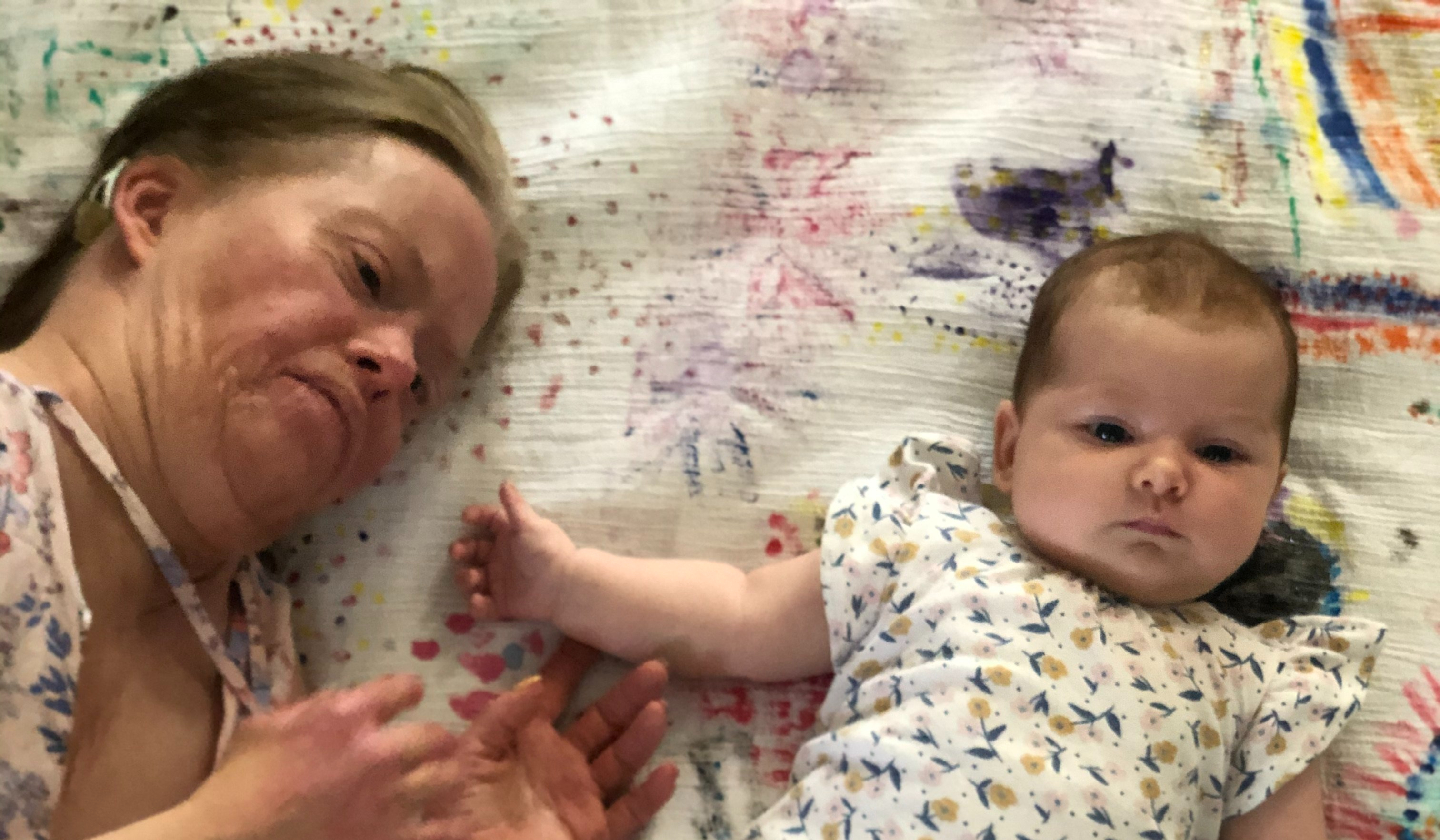
You might be wondering why I have not posted as regular as I said I would. I believe most people will be cutting me some slack, because this was to be, in part, a travel blog.
In our new COVID worlds of 2020 and so far in 2021, no one is travelling anywhere too far, so unlikely no expectations have been blown.
(I know there are very few people even aware of this blog, so really, I have not had anything to worry about from an accountability factor!)
However, I have still been wanting to post things about Wendy’s childhood, her health history, her past travels, her times living with us and her processes of grieving the passing of our mother.
My main reason remains for having this blog; possibly even further validated by the last year, that there is little real-life data around publicly on aging Down Syndrome adults.
The overriding thoughts I have been having for almost a year now, has been focused on trying to work out what has been going on with, Wendy in relation to her behavior, emotions, and cognitive abilities.
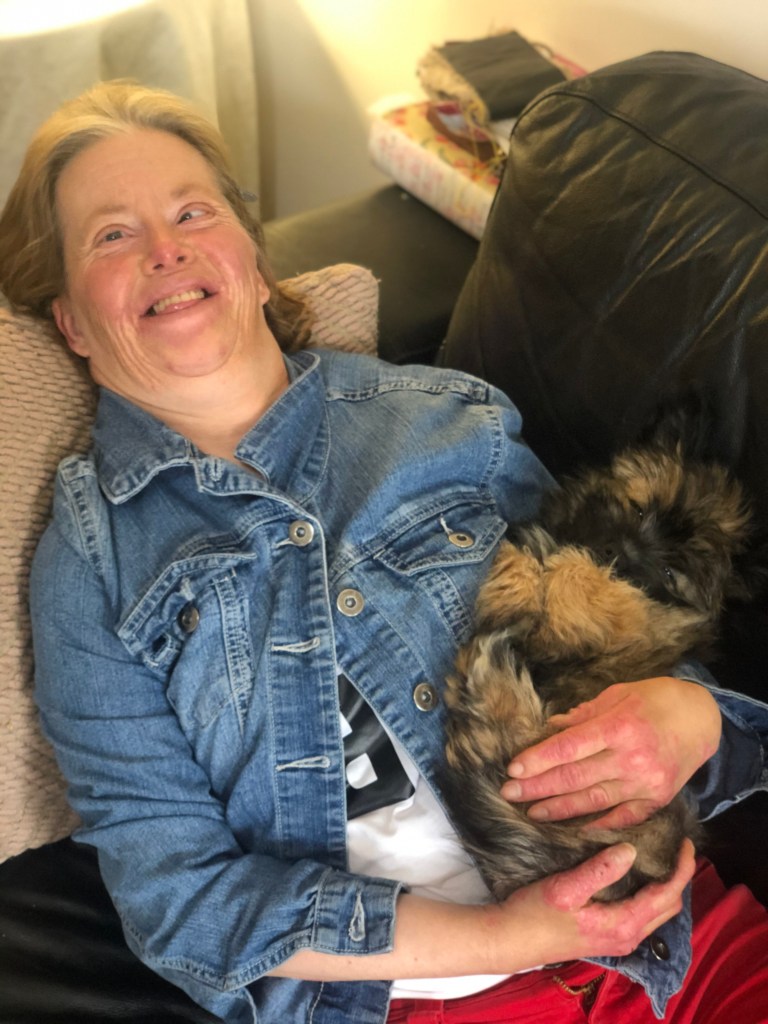
2020 What a year
Day programs had stopped by March 2020, we were all globally living with COVID changes. Wendy was not seeing her normal social groups, but she was fortunate in that she had her family unit with her daily.
I noticed Wendy was grumpier, less tolerant, and more impatient. While on the other hand she was telling us that she “did not miss going to group”, “did not care to see her friends”. She really liked being at home so maybe she was saying one thing but acting out another? I did notice too, that a lot of people who we would normally see; Wendy was not asking about or caring to see.
There was plenty in the media about COVID-19 effecting peoples mental health, so I thought maybe this was what was happening to Wendy.
Life as we all knew it was altered and limiting. She stopped getting out of the car to come grocery shopping with me, I still invited her to come but I did not force her as she was deemed a “high-risk person” if she did get COVID.
Maybe in normal times I would have acted differently but maybe not, as she was noticeably clear about not going in. This was puzzling.
As the year progressed, I realized there were five things I was thinking about simultaneously to try to “fix” with the view to make her happier. To reinstate her quality of life as I could see it slipping away and as far as I could tell, for no physical reason.
As the days passed all these things became entwined and increasingly frustrating for me.
- OCD
- Dystonia
- Emotions
- Blood pressure
- Mobility
OCD – started not long before mum died, in 2017 and mostly behind closed doors, in her bedroom and bathroom.
She would wait outside the door and count before going in, close the door and repeat, opening and closing it for a certain number of times. Then in the room you could hear her hissing as she continued to count at the mirror as she undressed and folded her clothes (even if they were going in the wash)
Before coming out of the rooms you could hear her opening and closing the door just a little and bang them shut again for a specified number of times.
If I entered the bathroom or her bedroom, during her “private time” even after knocking on the door and talking to her before going in; she would react like I had scared her half to death and go off her nut at me.
Including the times, she had called out for toilet paper or her towel.
I was getting worried as to how long this would go on for, as the length of time it was taking for her to have a shower was getting longer and longer and if I gave her time deadlines she did not care.
When I did encourage her or question her, she would get upset that it was about “her” our mum, and that she missed her.
I let Wendy know I was missing her company too in helping to prep dinner with me, to watch TV with etc. She was my only girlfriend I had at home to hang out with. These chats did not make a scrap of difference. But I was noticing Wendy was also doing a lot less in the way of domestics.
As time went on, I was thinking in a year of no control, maybe, this was a way she was able to keep some control. Even though the OCD behavior had started before mum died. It might have been continuing and further developing as it was as a means for her trying to control her routine.
Mealtimes – Wendy has Cervical Dystonia – meaning the muscles in her neck contract involuntarily, causing her head to tilt backwards so she is constantly trying to realign herself forward, either by pulling her head with her hand or leaning against something firm.
Every three months she has Botox injections to the base of her neck to relax the muscles. There is a risk if she has too much Botox it could relax the Trachea (windpipe) and esophagus (food pipe) to the point that she would need to be fed via a feeding tube for a few weeks until the recent Botox drug effect wore off.
Wendy had her swallowing tested in 2017 as she was gagging and coughing frequently. The finding was, that she had a degenerative condition not necessarily due to the dystonia and not because of the Botox.
Due to increasing episodes of coughing, gagging, and choking I naturally adapted her food to be softer and easier to eat, also cutting stringy foods smaller like baby silver beet, string beans, celery, and lettuce leaves. It is often easier to pop some of these things into a smoothie for her.
During 2020 Wendy was eating slower and slower but it was not just the slow eating; it was that her hand movements, to get the food to her mouth, was and still is, at a pace of a sloth.
Is this a behavioral act to fill in time, OCD, or something she had no control over? When each meal or snack is taking 1-2 hours to eat, an abnormally large portion of her days are being spent eating. This is not ideal for anyone.
Mobility – Wendy has always loved walking, but dystonia has really slowed her down and holding her head is quite fatiguing, so for longer distances she has a wheelchair but for short distances like local shops, workplace and moving around at home she is independent, slower than she had been, but it was a bearable walking pace.
In April I noticed Wendy was taking much smaller steps, and then was varying her steps by what part of the house or yard she was in. Was this OCD expressing itself further, or was it a new “Downs” behavior? I tried to ignore it, then accept it, but it kept getting worse down to less than a centimeter per step.
I tried to address it by talking to Wendy, then with her OT, physio, and doctors. There is no physical reason why she cannot walk properly as she still would walk ok at times.
Low Blood pressure – Wendy has always had low blood pressure and honestly, I do not know how far it goes back; all her life, or something that developed later? But since she has lived with us, I know she has had moments of it affecting her.
She would just randomly need to sit down or stop where she was and hold her head. During 2020 this became a lot worse and until she began to verbalize the feeling as like her head being on a merry go round, and nightlights when we were out in the car bothering her. I knew we had something different on our hands.
Mum had had vertigo and it seemed Wendy did too, but I continued to think of it as low blood pressure. It was selfish of me; I did not want it to be otherwise.
Emotional – Wendy was always best described as fun, happy, cheeky, and at times succinctly sassy. In 2020 Wendy was losing her characteristic “Downs syndrome” traits of natural loveliness of affection, care, and genuine empathy.
She simply did not care if you hurt yourself, were upset about something, had a bad situation going on, everything was met with a “so what”, “I don’t care”, “whatever” or a big outburst of laughter.
Overall, she was grumpy and impatient; I put it down to the overall emotional situation and uncertainty of COVID. What else could it be?
If we were to question her choices or to encourage her to do anything against her will, she would start to cry or even worse drop down to the floor like a toddler crying.
Her cry is a wailing, sob that just drags at my heart and I just cannot cope with her crying. Knowing too, how infrequent she had cried ever, in her first 51 years, this was a huge flag that something really was not normal. I believe I am not exaggerating in saying I had not even seen her cry five times up until this last year.
Wendy started to say to me, “it’s my brain” “my brain is stupid” “my brain isn’t right” and “my brain is like hers isn’t it” – Hers; meaning like our mums, as she would point at a photo of mum.
I wanted to explore other options first rather than delve into the one that was becoming obvious, but it was ok to skip it as Wendy’s memory was overall, in great shape. Was it not?
What is going on?
Looking at everything as one condition rather than five separate ones came around June after a major accident in May when she fell out of her wheelchair, while out with a caregiver. There were more changes and challenges going on which I began to google and make enquiries about.
One of the girls who works for us is doing a degree on social work, she knows Wendy well, and as a result of this decided to do an assignment on “aging down syndrome”. She brought to me a few research papers around the high prevalence of Alzheimers in down syndrome adults.
With my googling, asking around; not coming up with anything else I went into reading about Alzheimers in Down Syndrome from the angle to try to disprove it for Wendy. What stood out at me was how differently the disease presented itself in Downs adults compared to the rest of us.
Soon I was taking more care to document my observations and experiences with Wendy and, changed my approach with Wendy from trying to “fix” her to accepting what was and is going on, as out of her control too.
True acceptance is not far away with the official diagnosis due before the end of March.
It is time for me to write this post as I know my language will change once diagnosis is confirmed and I wanted this post written before I really know the answer and go through the next level of emotions; which I am keeping at arm’s reach for now by keeping busy in collating and documenting. I can see myself in a place of busyness and filling this pending void time with a mix of creative avoidance and preparation.
After having gone through the horror of Alzheimer disease with mum and knowing and observing all that Wendy has been though in her past. Acknowledging that now, it is most probable for her to have to deal with this type of degenerative disorder to the finish line, is unbearable to give in, to any true emotional energy until its officially spoken.
One thing I do know we will need, and we will have, is the love and support of family and friends, for which we are grateful for in advance. Some have the long history of being beside Wendy for her four open heart surgeries, others have only known her as an adult, healthy, happy, loving, generous adult Wendy.
Wendy also has a lovely supportive network in her care system through NDIS that we will journey closely with too who love her as she is now.
Wendy even at this stage is “Lucky” – just ask her “I’m lucky aren’t I”
Wendy is “lucky “as she is among the early movement of mums who stood up, feeling empowered to take on callous medical recommendations to leave their “Mongoloid” babies in institutions to die.
Mums choosing instead to act on their maternal instincts, they believed in themselves to take their baby’s home to love. They put faith in their family and friends to support them and to soon see their baby as they did, delightful little people to love.
I know I am grateful and feel eternally lucky to have Wendy as a sister, I have seen the impact her life has had on so many people. She has always radiated love and shown courage, strength, faith and might; that could and has inspired men, women, and children.
Wendy is a survivor of congenial heart conditions when open heart surgeries came with massive risk, essentially when people were guinea pigs, trialed and tested upon. With Wendy at age 6; being given a 1% chance of survival; with a 100% assurance of death without it. Dad said the other day to me. “She really had no chance, but we had to give her the 1% chance that was before us”
She took each of her heart operations in a stoic, angelic manner, “I’ll live” giving us, her family, the courage and faith to dare to believe she would.
Documenting this next part of her journey is important to me for there are many other families to travel this same path behind us. I know the questions they will be asking, the very questions I am asking right now, which are difficult and, in some cases, impossible to find the answers to.
I have learned, on the ground, in the house, actual documented case stories are not in the public domain in full, and I am sure has a lot is to do with
- Being highly emotional to write about.
- parents are older and not really into blogging or documenting.
- Many siblings who are caring often have their own teen children still at home.
- many of the Downs Adults with Alzheimer’s were in full time independent care living arrangements at the time of diagnosis.
Our mum and dad together in 1968, against all advice and social norms at the time bundled Wendy up and took her home to love. Loved she was and still is.
Documenting in a blog is the least I can now do as a legacy to mum and finish what she started 52 years ago through her handwritten diary entries to tell Wendy’s story all the way respectfully, and honestly.
My next posts will be about
- what I have learned to date,
- towards Alzheimers Diagnosis the internal dialogues
- the differences of dementia symptoms in Down Syndrome compared to the general population.
- where I found some of the data that does have me believing that Wendy does have some condition of Dementia.
- I will go into what I have documented, how and why.
Meanwhile, Wendy is getting loads of love, patience, security, and care, to get through this in the best way possible. But we have so much to learn.
If it is not Alzheimers I do not know what is wrong with her at all and I will be open to anyone’s input to help us forward.

 I'm lucky aren't I...